
The Amazons
Keeping the Spark Alive
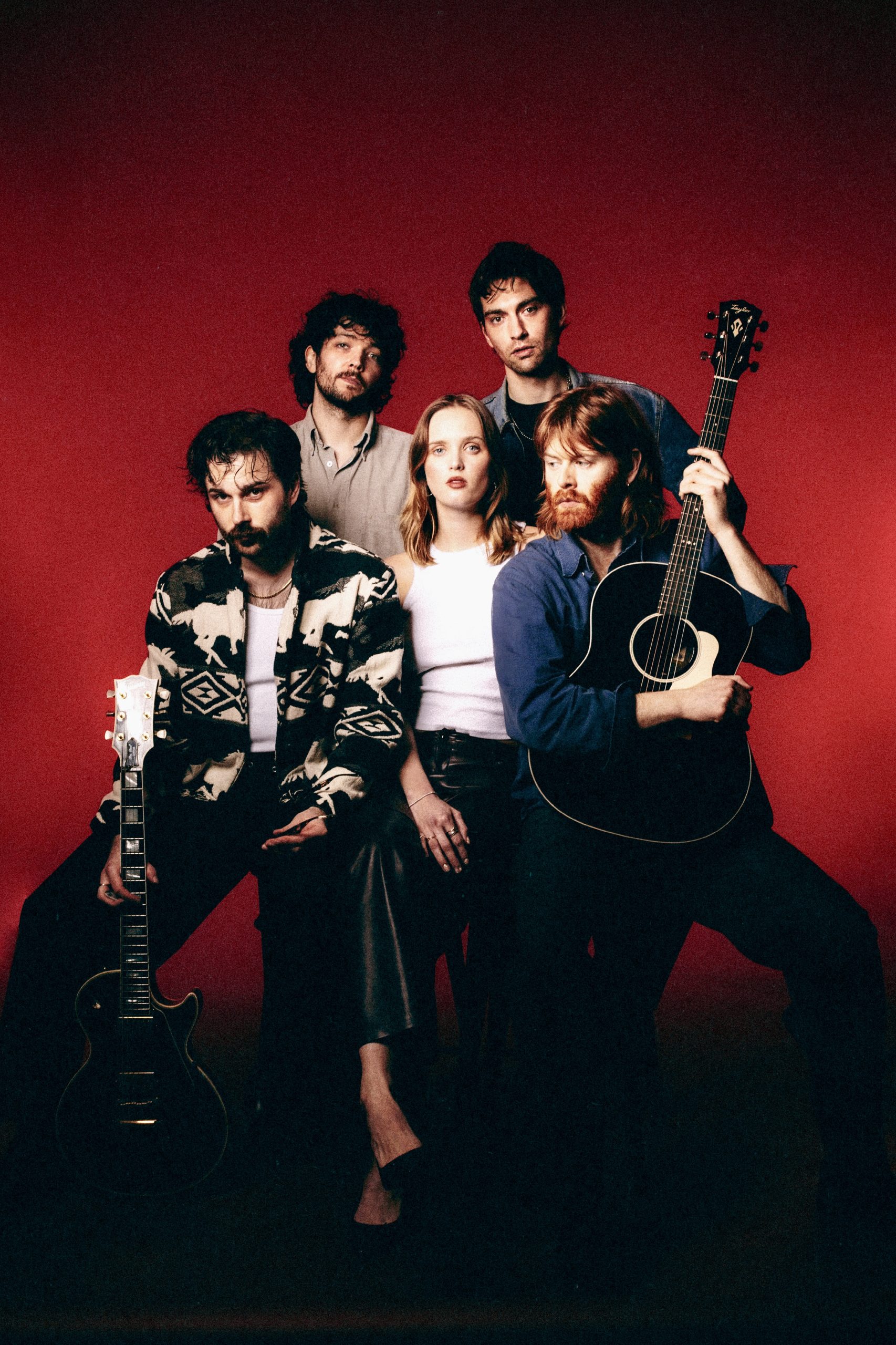
Ahead of The Amazons’ Tramshed show in Cardiff on 27 September, Matt Thomson discusses 21st Century Fiction: Epilogue, songwriting, changing line-ups and keeping the spark alive.
Your last record, 21st Century Fiction, felt ambitious. When did you realise there was still more of that story to tell through Epilogue, and that those four new tracks deserved to become part of the album rather than being left on the cutting-room floor?
I think with these songs, these four songs, it was half songs that hadn’t really been finished in time for the record, and that were kind of just gnawing at us to finish pretty much straight after we released the record. And then there were a couple, in the case of One Hot July especially, that we wrote in the time that Ella was joining the band for real, and that was our first totally co-written song.
We just really believed in 21st Century Fiction, and we wanted to go on tour again and kind of hit places, towns and cities, that we hadn’t the first time round. It all worked out that we had new music and more dates we wanted to do, so it felt like it fit into this particular album campaign.
“We just really believed in 21st Century Fiction.”
So, if someone has never heard The Amazons before, would you point them towards the original album or the Epilogue version?
I’d say the Epilogue, mostly because it builds on what we were doing on 21st Century Fiction, but I think it’s definitely a strong indicator of where we’re going in the future. Judging by the material that we’ve been writing recently, I can see Ella taking on more and more of a central role in the songwriting, and in the songs themselves. So I feel like songs like Blood on the Bone and One Hot July, and then we’ve got another one coming out at the end of August called Kicking In, are really good indicators of where we’re going sonically, which is exciting.
The band’s line-up has evolved over the years, with two long-time touring musicians now becoming permanent members. How has that changed the chemistry, both creatively and personally, and what do they bring to The Amazons that perhaps wasn’t there before?
Well, they’re slightly different additions in a way, in what they bring to the band. In the case of George as the drummer, that’s been a really long, kind of organic story. He was depping pretty much as soon as Joe left the band. George had been on our radar for a long time because he’s getting married to our long-standing photographer, Jess, so we’ve always known he’s been a great drummer. With George, he’s just a really cool, composed character, and then he steps on the drums, and he can really hit them, and he’s technically brilliant. I think he’s probably the most versatile drummer. He’s got a really great grasp of dynamics, so I feel that we can execute lots of different styles.
So, on our heaviest stuff, whether it’s Mother or songs like Joe Bought a Gun on the new record, he can really unleash. But then he also has much more measured drumming, like on One Hot July. We did a lot of takes on One Hot July where he was almost playing at full strength, and then we kept asking him to pull it back.
It landed on some really, really supportive and stylish drumming, still full of his character, but using like 20% of his strength just to let the rest of the song breathe. And that affected our playing. We were playing softer and more considered in the room when he just pulled it down a bit, and that’s what gives the song its really lazy, kind of late-summer-afternoon feel.
“Using like 20% of his strength just to kind of let the rest of the song breathe.”
It’s nearly a decade on from your debut. How has your relationship with songwriting changed? Are you chasing different things now than you were in your twenties?
Yeah, I think so. I think there’s more consideration for things like lyrics, because I know, over 10 years of songwriting, the songs that have lasted for me are the ones that I really painted a proper picture with the lyrics. They’re almost structurally sound in that way, like they have longevity in that respect. I think in the beginning, lyrics for me were kind of an afterthought, or just as long as they sounded good and they were all pointing in the same direction. It was all about how the music made me feel, and its urgency and excitement.
But I think over the years I’ve developed more of a worldview as an artist, as a lyricist. I’d say I came into my own a little bit more on the most recent record, and I’ve just been going in that direction. I think we’re better songwriters as a whole. I think there’s more of a craft to the songwriting now. Probably more consistent. I think the trick is, as you get older, not to let the spark and that kind of urgency leave you, if you know what I mean.
So, when you’re 22, when you’re writing songs, I would say most of them were terrible. Well, not just terrible, but they were strong melodic ideas, but there really was no craft to them. I didn’t have the experience, or didn’t have the skills, to execute a vision for the songs. I didn’t know how to finish them, or I didn’t know how to put them together in a sophisticated way. So when we did have success with a song like Like Magic or In My Mind, it was kind of like a doozy where you’re like, “I have no idea how I’ve done that.”
That levels out the more you do it, but as you get older, you need to kind of hold on to that messy efficiency. That’s the sort of thing that really supercharges hooks and catchiness — and with rock and roll, a lot of it’s based on just energy and feeling, so you can definitely let that slide. So that’s probably the trick: getting that kind of songcraft that you’ve learned from experience to be sophisticated and to give the song depth, but not to lose that initial spark, which will eventually go, as history tells us. So definitely, you know, making hay whilst the sun shines, I think.
“I think the trick is, as you get older, not to let the spark and that kind of urgency leave you.”
Do you think then, as a songwriter, that the best songs are discovered, or deliberately crafted?
Great question. I think at the point of inspiration, it’s nothing but discovery, really. They just come, basically, and there’s no rhyme or reason. You could be playing the same chord progressions you did the day before, but you sing some different melody, and here we are, and then you’re on to something. I would say now I’m better equipped to capitalise on discovery and inspiration. I think a lot of the time when I first started songwriting, I wouldn’t even know. I’d have great ideas, and I just wouldn’t know how to capitalise on them very quickly.
So, yeah, it’s a bit of both, really. It really is a bit of both because, if you’re Paul McCartney, I really don’t think you’re accomplishing Yesterday if it’s in his batch of first 20 songs, even if he might have. Because I know with McCartney, he had the melody for When I’m Sixty-Four early, early days when he was playing around on his family piano as a teenager, but then he revisited it later on, with almost the experience and basically the expertise to be able to deliver it. Yeah, it’s just a mix of both, really.
Does that mean you’ve got songs that you were playing with when you were like 10, 11, 12 that are still in your head? Have you still got them somewhere in your back pocket?
Yeah, definitely. There’s one song — God, I’ve been trying to write a verse for a particular song. It’s basically the title track of 21st Century Fiction, and I’ve had this real knockout chorus for ages, probably since before we even started writing 21st Century Fiction. I’ve gone through maybe like 20 verses, and it’s to the point now where I don’t even know if I would understand whether the right verse is the right verse.
At some point, you’ve just got to settle. Sometimes you can really create pressure on yourself. It’s like, I write a really great chorus or a great section, and it’s, “Oh God, the pressure’s on to make the rest of the song really good.” But sometimes you grind yourself into submission, accept what lands in your lap, and go with it. But yeah.
You’ve played everything from tiny clubs to the biggest festival stages in the country. Is there one performance that changed the trajectory of the band?
Changed the trajectory of the band? I mean, whether or not it changed it, there are definitely shows where we felt in the driver’s seat, like something’s happening.
Definitely, I think Reading Festival. Those were moments because they’re just great barometers of where you’re at. Can you fill out the tent? And really, with the festivals as well, you can see how far the name is travelling because you get a lot more casual fans and stuff. We played the NME Stage at Reading Festival in 2019. That was a big one for us. We felt like it was a moment, and we rose to it. Maybe there were earlier moments, earlier opportunities on our first record where we didn’t feel like we rose to the moment.
I mean, really, I can’t speak for anyone who’s at the gig. I can speak for our experience, because you always have an idea of what you can achieve, and then you’re just a slave to your own standards, really. It doesn’t matter how many people kind of tap you on the back and say, “That was great.” Really, if I don’t think it was, that really is all that matters. Only because that’s the main driver of progression for the band and how we learn and grow and develop, based on the standards that we have.
So, back to your question: a really great show we had was supporting Muse at the San Siro in Milan. That was a moment. That was a real moment because we’re football fans, and we were really young, so it was just a great combination of personal history, wider history, music history, football history. It was just great. That stadium is just groaning with stories, and it looks like it’s going to fall down at any point. So it was great.
“You’re just a slave to your own standards, really.”
You’ve built a career in a world where everyone’s competing for attention. How do you stop yourselves from making music for trends instead of making music that genuinely lasts? Because I know you guys aren’t all active personally on social media — you like the music to do the talking.
I think that’s how we grew up, really. I remember using our Twitter quite liberally when we were first starting out, and our early manager told us not to. I remember it was just to kind of stick to the music type thing. And then I remember our drummer, Joe. We played the BBC Introducing Stage at Leeds in 2015, and he turned up in a Jeremy Corbyn shirt, and our managers were like, “Just don’t get involved in this sort of thing.” Those were, you know, when we were in our early 20s, and you’re like, cool, you’ve let us into the club of playing, and don’t throw us out. If you don’t think we should do that, that’s cool. We won’t.
So I guess, in that respect, we’ve always taken more of a — well, we’ve just never really stuck our oar in on anything, really. And I wonder if that is the right thing because we do actually, in the band, have quite strongly held convictions. I think if I go on some more emotionally or politically charged rant on the band’s Instagram or something, you know… We usually align on stuff in the band, like everyone, unless it’s something that we really, really care about, I guess.
How do we make music? I mean, we really make the music that we want to make, and that’s such a cliché. But there are so many miles that you have to travel. The road’s long, basically. If you fill your car up with the wrong fuel, you won’t last very long. It’s as simple as that. You’ve basically got to make the art that sustains. Otherwise, you’ll check out. Social media is so unrelenting. You always have to be on. You always have to be, in a way, selling but not selling, or find a way to spread your music authentically. And if the music’s not authentic to you and your tastes, then you’re on to whatever.
But I think most of my heroes are from the 20th century. I mean, my touchstones and references are in the 50s, 60s, 70s, 80s. So, you know, we’re not going to be making a Fontaines D.C.-sounding record anytime soon. Basically, it’s just not going to happen. It’d just be disingenuous.
“You’ve basically got to make the art that sustains. Otherwise, you’ll check out.”
Has there ever been a song that everyone else in the band believed in before you did? If so, what eventually changed your mind?
Let me just look at our discography… Yeah, I think everyone really liked… Ooh, yeah. We had a song on this new album called Pitch Black that I thought was cool, but whatever. I delivered it to the band in a pretty raw, rough form. That’s kind of our process, really. So I’ll write my initial songs on the acoustic or piano, give it a title, write a rough lyric together- this, like, deranged, messy, messy, messy demo- and then I’ll deliver it to the guys.
Then we’ll all produce it. Chris, our guitarist, will lead the charge and put it back together, and we’ll all do the demo together. He went to town. He was really inspired by what I’d done on Pitch Black and just took it in a different direction. I wasn’t really that impressed, but the changes he made to the arrangement got me excited again, which was really cool.
Actually, me convincing everyone that we have to do X and Y because it’s brilliant — that’s usually how it goes.
“We’re not going to be making a Fontaines D.C.-sounding record anytime soon.”
To follow up on that, how do you deal with any confrontation in the band when it comes to what goes on the album and what comes off? You’re the songwriter, but obviously you’re a collective as a band.
Yeah, usually by the time we get into the recording, we’ll pretty much know what’s going to be on the record. I think gone are the days when you go into a big old studio with 20 songs. Because the tools we have at home are so advanced for demoing, we demo and demo and re-record and re-record, to the point where a lot of it ends up on the record anyway. So that’s just a way of illustrating the point that, by the time we get to the studio, we already know what we’re going to do.
I would say the editing from the band really starts at the beginning, and there’s no confrontation because I’ll play them a song in practice and it will just be met with crickets if they don’t like it.
Because Ella and I have been writing more, she experienced that for the first time the other day. We were like, we’re really excited about these songs that we’ve written together. We’re going to play them in practice to the guys. And then we were like, “Here’s our song,” and presented it, and it was just crickets.
She was like, “What the heck?” And I was like, “Don’t worry. This is just” They don’t want to say they don’t like it. They don’t say anything. “It’s fine, it’s fine. This is it. Welcome to the band.” Well, that’s fine. That’ll end up on my solo album. So, all good. [Laughs]
The Amazons bring 21st Century Fiction: Epilogue to Cardiff’s Tramshed on 27 September, as the band continue their latest run of UK shows.
Interview by Carl Marsh
More Interviews

Whoopi Goldberg


LATEST INTERVIEWS

David Morrissey

Alicia Coppola

Sorabh Pant

Simon Reeve
James Norton

Heida Reed
INTERVIEW DIRECTORY