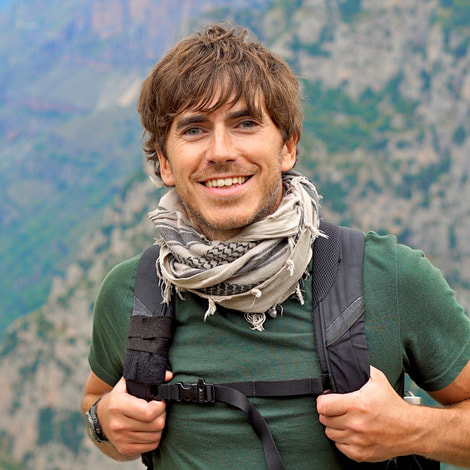

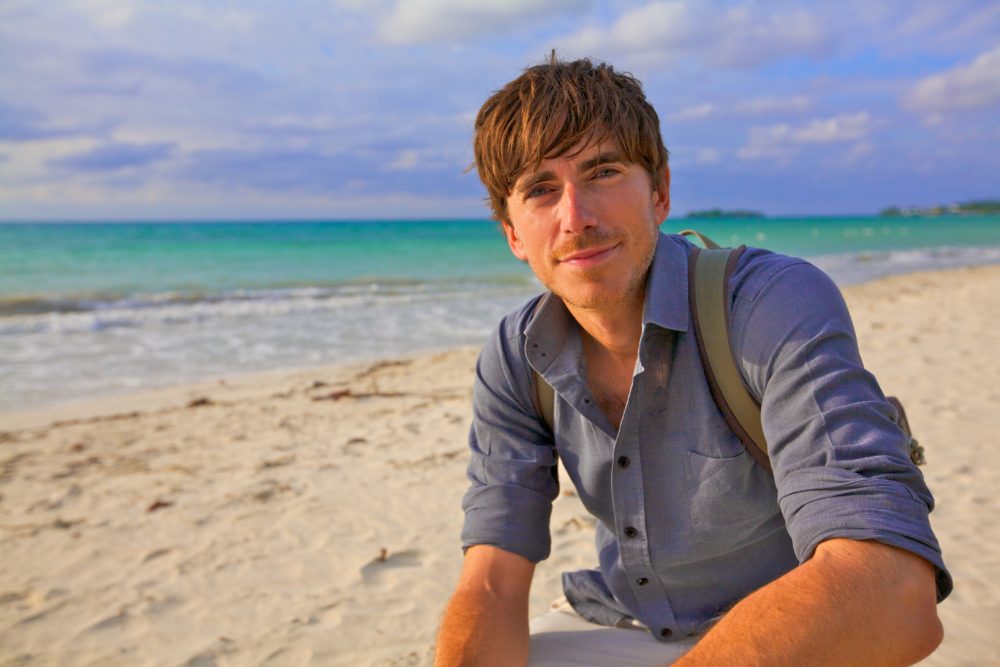
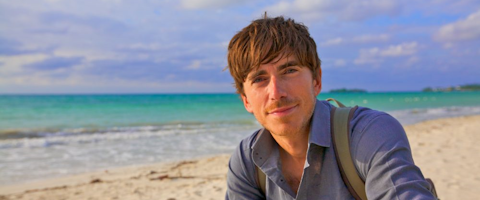
Simon Reeve
Beyond the Headlines
Best known for his BBC travel series exploring some of the world’s most complex regions, Simon Reeve discusses risk, perception and why travel still matters.
Do you think the way the world is reported makes people more fearful than they need to be?
Well, there is no nuance; there are not as many dimensions to it. If you look at our news about the world, it’s a big place, with lots of things happening there, and we generally hear the most dramatic and desperate stories, so if you watch the news, you might think the world is going to hell in a handbasket. I am not denying there are important problems out there by any means, and environmentally, what we are doing to the planet is catastrophic. Still, there has never been a safer time to be a human being, and never a safer time to explore the world, despite what people might think.
I am very keen that people don’t live their lives on their knees, not being put off by fear and scare stories. I really mean it, if you wear a seatbelt, that is the single most important thing you can do when you are away travelling. You have got to use your common sense; if it doesn’t feel safe, then you walk. This is honed over time and through experience; you have to get out there and do these things to build that knowledge.
“If you watch the news, you might think the world is going to hell in a handbasket.”
So, really, then, people overcomplicate travel when it’s often just about saying yes and going?
It doesn’t have to be, although as is often the case, the further off the beaten track, the more memorable the experience will be, but you can also do it locally; it’s not just about travelling to the other side of the planet. I’ve had some solid advice from people over the years about exploring where you live, but do it in a more adventurous, interesting, and memorable way. It is all about travelling and living with your eyes open, and grabbing opportunities while you can, and pushing yourself out of your comfort zone. If you are on holiday, this can be as simple as not eating in a restaurant that has pictures of the food outside! It can be about asking what the most interesting thing to eat, or the most interesting place to go, is. Just challenge yourself a little bit.
Personally, this (travel) has brought me the richest rewards and gifted me some really incredible memories. And that is what travel can do to a person, and that is what I am most keen to pass on to people through what I do. I have been very lucky and have travelled the world visiting about 120 countries, but nobody is more surprised about that than I am. I didn’t grow up like that; I didn’t take my first plane ride until I started working, so I definitely don’t take it for granted!
Is there anywhere you wouldn’t go, or does curiosity always win?
No place is off-limits to me, but I am not the only person who decides where we go; the BBC has to ‘ok it’. I generally come up with the ideas, but within those ideas, there are different places, riskier places, safer places and sometimes they (the BBC) will say ‘that place’ is too dangerous and we cannot sanction you going there. But really, there is no place I would ever say “no” to; if we are allowed to go, we would go. If we can reach a place with people willing to host and look after us, we will head there. This is all based on my knowing that the world is a much safer place than most people think or fear. As long as you wear a seat belt and take some basic precautions, you can go just about anywhere and do almost anything.
“It is all about travelling and living with your eyes open.”
When you’re filming in places like Myanmar, are there things you feel you can’t say — or do you always try to include the full picture?
No, there was nothing we couldn’t talk about, because if we felt it fit and we could make it work, we would put it in if we thought it was important. I filmed in (Burma), Myanmar, before with a Christian minority who had faced horrific human rights abuses. In this series I just completed, we filmed with the Shan people in eastern Myanmar, who are mainly Christian. Their Christian identity isn’t the most important aspect for them, but it matters; that’s not why they are being persecuted. They want their own Shan state, but the Myanmar majority doesn’t want it. Certainly, the persecution of Christians around the world is one of the biggest unreported human rights stories on the planet at the moment. There are hundreds of millions of Christians under threat, and not just in the Middle East, but also in Southeast Asia. It is something that we have worked into programmes, and I have just been filming in the Middle East, filming that very issue about Christian communities being wiped out, so I am very conscious of it. It is something we should never ignore.
In the programmes I make, they are usually travelogues that blend ‘light’ and ‘shade’. We don’t shy away from really serious issues, and that is partly because it makes for a more interesting journey. When you learn about a country you are visiting, you learn about its problems and challenges, and you get a more rewarding understanding of the place. A lot of people shy away from asking questions like “What do you believe in?” They are reluctant to do it because they get all British about it, but actually, everybody wants to talk about those sorts of things. If you do it in a polite and open way, then you can have a more rewarding holiday and journey as a result.
That balance in your programmes — showing both the beauty and the reality — feels key to what you do…
Well, thank you for saying that, as we do try really hard to make it work like that, we try to mix in unusual stories from places, stories that people won’t have heard before, counter-intuitive stories, which is part of what we set out to try and do and surprise people. What we are trying to do is dig up stories that are a little more surprising and that show how a country or region is really changing, frankly.
“What we are trying to do is dig up stories that are a little bit more surprising.”
You mentioned earlier that you didn’t even get on a plane until you started working — how did that journey into this career actually begin?
I had a slightly unusual route in that many people who work in TV happen to have gone to public school and to Oxford or Cambridge Universities. My background is a bit more hopeless: I left school with no qualifications and went on the Dole. Leaving school was a very traumatic time for me, and I really, really struggled. It was a really horrific time in my life, and I was completely lost, very low, and went for some jobs that I didn’t get. I tried for a job as a white van driver and was rejected, even though I was the only person who applied, which really hurt! Eventually, I got a job as a postboy for a newspaper, and that is when my world began to open up. I would sort the post for hours every day, but one day I had my big break when I was sent to find these two South African Neo-Nazi’s who were on the run in Britain, and I went and found them, as you do! So that was my first big break, which led to me going on other jobs and which led to writing, where I wrote books on terrorism. That was ultimately how I got into TV: I wrote a book about al-Qaida before 9/11 that nobody read, so when 9/11 happened, I suddenly found myself on TV talking about it. So that led to my little career, really. Initially, the discussions that I had with the BBC, well, let’s just say there were some daft ideas, such as me infiltrating al-Qaida for a TV series, and I didn’t think that was a great idea! We then settled on making programmes for parts of the world that weren’t always on TV or never were. And that is what I have been doing ever since.
You’ve since explored places like the US as well — was that always somewhere you wanted to cover, or did it come later?
It was definitely one we had talked about, but I don’t get to pick what I would like to do. I have to put forward ideas to the BBC and discuss them; they also have their own suggestions and priorities, as the BBC works across different channels where people are making different programmes in different parts of the world. The BBC certainly wants to make sure they are covering the world in different ways, so I get to suggest places and ideas, and if it fits, nobody else is doing it, and if I am very lucky, I get a gig. My biggest passion is for telling stories about “Us”, our brothers and sisters on this planet. It has been an endless source of delight to me to meet exotic, unusual, eccentric, bonkers and wonderful people around the world and to discover our similarities as well as our contrasts, our differences. That is my favourite aspect of the job. I love the wildlife, I love the landscapes, I don’t even mind the food, to be honest, as it is all different and varied, but I do really love filming the environmental stories.
“I left school with no qualifications and went on the Dole.”
Across all of your travels, what stands out as the highest high — and the lowest low?
That’s a great way of putting it! My ‘highest high’ for me was coming out alive from a prison in Honduras that the inmates controlled. We went in there to talk to gang members from some of the most dangerous gangs on planet Earth, and to get in there, we had to take a bodyguard. So we were thinking “Do we take a Special Forces guy” or some self-defence expert, but no — the only person that could guarantee our safety was the Bishop of the city of San Pedro Sula, who could walk us into the gang wings of an inmate-controlled jail, and walk us out alive. And that was one of the most extraordinary places I have been on this planet. It was a cross between a sweat shop and something out of Harry Potter. It was hundreds and hundreds of people crammed into a small space, but there were little cafés, barber shops, people making knives, candles, clothes. There were all these gangsters inside the jail, still carrying on their activities as normal. We walked through there, and it was one of the scariest and weirdest places I have been to. Coming out safely was an epic high. We had felt like we had walked into the den of lions and escaped alive. It was a really mind-opening place to go to — to see these people who had tears tattooed on their faces to depict how many people they had killed, and talking with them as human beings. One of them, in particular, was obsessed with telling us about this nativity scene he had been building from recycled plastics — it was just weird beyond belief. When we got out of there, we were on this mega high from what we had done and seen, and from having experienced and survived it.
The ‘lowest low’ was contracting Malaria very stupidly because I wasn’t taking my tablets in Gabon in West Africa. Vomiting up blood in the middle of the night, I thought I had Ebola, which is even worse — I was actually quite relieved to discover I had Malaria. I had a temperature that was a fraction off, giving me brain damage. I was hallucinating, and I thought Mr T from The A-Team was in the room with me and looking after me. It was all very weird and horrifying, and I thought I was going to die and that my life was all going to end there. I was given a miracle drug derived from Vietnamese sweet wormwood, and over weeks I gradually recovered, but I have never felt the same since.
Does the reality of what you do ever make life at home more difficult?
(Laughs) Well, I think she keeps on whacking up my life insurance! But in all honesty, she understands that this is the job and this is what I do for a living, as mad as it sounds. There are much harder jobs out there. As I am not away for ridiculous amounts of time, I try to limit trips to 3 weeks now.
“Coming out safely was an epic high. We had felt like we had walked into the den of lions and escaped alive.”
So it’s not months on end — it’s intense bursts instead?
I’ve got a son, and he would be calling Social Services (laughs). We cram it all in, but it is a crazy ratio when you look at it — we have 3 weeks of travel to make a few hours of TV. We have a small team, though, and we travel light, or as best as we can.
When you say a small team, how stripped back is it really?
It’s three or four people with me (laughs).
Including security?
I don’t usually take security — if I do, it is very, very rarely. We rely on local guides for expert advice. Often, though, when I am actually filming a scene, it is just the cameraman and me. I am just looking through the lens, and there aren’t many people behind the camera. It feels intimate, and I like it that way because I am trying to talk directly to the people who are watching.
Three or four of us will travel out, which includes me. We don’t have a sound recordist — the cameraman does everything, basically, to their immense credit. I generally film with a guy called Jonathan and a guy called Craig, and whoever else will put up with me and is available. Their involvement is never fully acknowledged, but they do the heavy lifting and the hard work. When I am walking forwards and nattering away to the camera, they are going backwards carrying 14 kgs and trying to keep it in focus — it’s a hell of a challenge. Not everyone will do it, and we are very lucky that they agree to be involved because they are some of the best in the business. We can’t go dicking around on the BBC licence fee for hours or days — we have to get the footage in the can and move on.
Have there ever been consequences for people who’ve spoken to you on camera after you’ve left?
As far as we are aware, there was no impact in Myanmar, but we are always mindful of these matters. I have had situations where people we have met and have been seen on camera — secret police have picked some up after we have left. There was more than one occasion when they knew they were likely to face consequences as a result, and one guy knew that he would be arrested and beaten up — and he was, in fact, arrested and tortured after he talked to us. He was tortured about just what he said to us. So I want people to remember this when they see the programmes because this is what people are prepared to go through to have their story seen and told. I hope it brings home to people the importance of that power to have their voice heard — it’s still a very profound thing, and people are willing to risk their lives to help viewers learn a little bit about what is going on in their part of the planet. That is astonishing. So, with that, there is this huge responsibility to tell their story as well as we can for them.
“People are willing to risk their lives to help viewers learn a little bit about what is going on in their part of the planet.”
And if there’s one thing you want people to take from all of this…?
As much and as quickly as they can! We must really want people to get out there and enjoy what is possible on the planet. I come back to that point from the beginning — it’s the golden age; none of our ancestors could ever have imagined this would be possible; it is a blessed time to be travelling.
Simon Reeve is a broadcaster and author known for his BBC travel series exploring remote and complex regions around the world.
Interview by Carl Marsh
More Interviews

Whoopi Goldberg


LATEST INTERVIEWS
David Morrissey
Alicia Coppola
Sorabh Pant
Simon Reeve
James Norton
Heida Reed
INTERVIEW DIRECTORY