
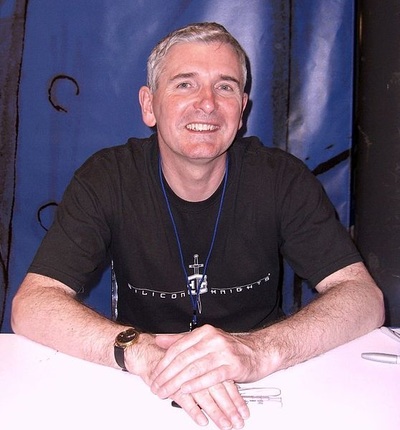
M.R. Carey
Stories Make You Bigger
Best known for The Girl With All The Gifts and Fellside, M.R. Carey discusses storytelling across comics, novels and film — and why stories expand who we are far beyond our own lives.
Are you one of those writers who, wherever you are in the world, when you pass a bookshop, you go in and start signing — or do you resist the urge?
I’ve never done that. I can’t resist the urge to check which – if any – of my books are in stock, but I don’t go to the front desk and say, “Hey, guess who I am.” It would feel kind of egotistical and absurd.
And how humiliating would it be if you offered to sign and the assistant said, “No thanks”? That scene haunts me in Young Adult, where Charlize Theron is thrown out of a bookshop for signing her own stuff without permission. That’s the stuff of nightmares.
“How humiliating would it be if you offered to sign and the assistant said, ‘No thanks’?”
Writing comics has been a big part of your work, but when The Girl With All The Gifts was adapted for film — which you also wrote — did you feel the need to change much from the book?
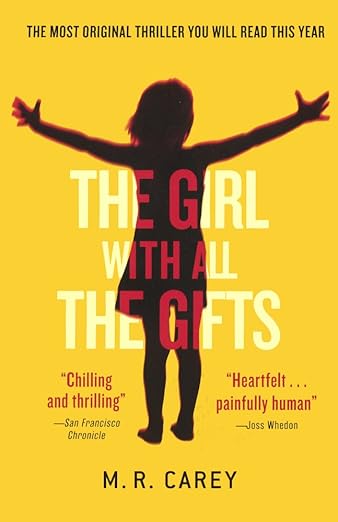
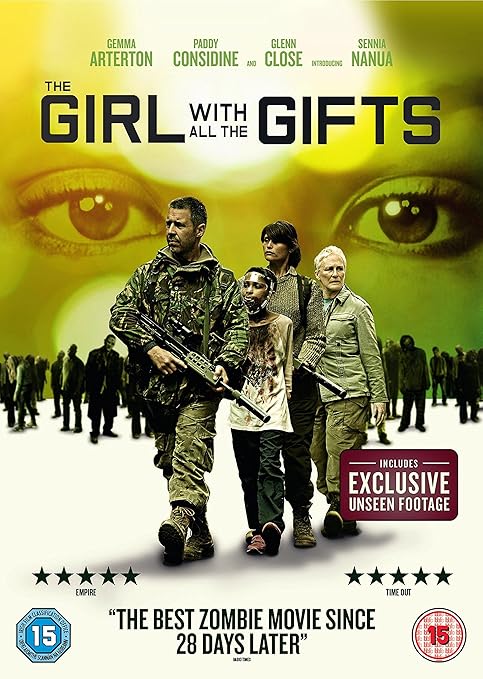
The situation is actually a fair bit weirder than that. I wrote both the novel and the screenplay off the back of a short story entitled Iphigenia In Aulis, which appeared in the anthology An Apple For the Creature. So I was working on the prose and movie versions simultaneously. They did diverge quite considerably. There were things that made sense in the novel that didn’t feel like a good fit for the movie, and vice versa. In particular, the novel introduces a range of viewpoints. Melanie, as the protagonist, is the primary POV character, but we also see some events through the eyes of Miss Justineau, Dr Caldwell, Parks, and even Kieran Gallagher. The movie sticks with Melanie’s point of view throughout, and it’s very rare indeed for us to see any events that she’s not present for. That was a conscious decision, and I think it works. Novels can get away with being expansive and discursive, whereas movies often work better when they’re focused to a point. There is a sense in which every medium comes with its own built-in tool kit.
“There were things that made sense in the novel that didn’t feel like a good fit for the movie.”
Some of the film was shot in Stoke-on-Trent, my home city, and there were suggestions that it might portray the area negatively. Do you think that’s fair, and what did the production give back to the area?
You know, I don’t think it does portray the town like that. We didn’t choose the Midlands as our shooting base because it fitted the post-apocalyptic vibe. We chose it because it had the right mix of urban and rural settings all within easy reach of a production base that we could afford. A lot of the London scenes, for example, are shot in parts of Birmingham that are actually very beautiful. We had to apocalypse them up quite considerably. Elsewhere, we obviously had to search for decayed and abandoned sites to achieve the right look and feel. But even then, Colm [McCarthy – Director] found a kind of beauty in the way the man-made structures had been partially reclaimed by nature. Nobody is going to watch the movie and think, “Man, I’m staying away from there!”
In terms of giving back, the director and producers were very committed to using local talent both in front of and behind the camera – and this was explicitly discussed with our backers, including the BFI and Creative England. A lot of the supporting cast were from the Midlands, and likewise a lot of the crew. Our female lead, Sennia Nanua, was born in the area and still lives there. We spent the majority of our budget there. I didn’t read any negative comments in the local media. If there were any, I think they’ve missed the point.
Your novel, Fellside, followed The Girl With All The Gifts — what did that story allow you to explore that was different?
It’s a ghost story set in a women’s prison. The protagonist, Jess, is accidentally responsible for the death of a child and is then haunted by the child’s ghost. She’s also thrown into a terrifying undeclared war with the prison’s most powerful fixer, Harriet Grace. It has very little in common with The Girl With All the Gifts, except that it, too, has a quasi-parental relationship between a woman and a child at its heart. In this case, though, Jess’s relationship with the ghost of Alex Beech is a lot more complicated and fraught with dangers for both of them. You might wonder what a dead child has to fear. In this case, the answer is: a lot.
“It has very little in common with The Girl With All The Gifts.”
You were a teacher for many years — do you miss that life at all?
Not so much any more. For the first few years after I quit, it felt very strange to me to be working alone in a tiny shed while all my friends who were still teachers were meeting 200 new students. My world seemed to have got much smaller and quieter. But that’s an optical illusion. Right now, life is as crowded and noisy as it’s possible to be, and I’m far from complaining. There is a sense, though, in which it’s good for a writer to be out in the world rather than sitting in a shed. Teaching, like any job, plugs you into human nature and human relationships. It gives you lots and lots of raw material for your imagination and your fiction to work on. In that sense, I miss it. But I’m certainly getting a lot more writing done since I quit.
Do you think we need to get back to a place where reading is more normal — where more people are engaging with books?
I kind of like that internet meme that goes “whoever said they were sorry they only had one life to live had clearly never read a book.” It’s cheesy, as all these things are, but it expresses an important truth. Actually, I’d go further. Our sense of self is really no more than a story we tell ourselves about who we are – a narrative centre of gravity, as Daniel Dennett puts it. Not reading stories or watching them is like choosing to be a recluse, to live in a self-imposed exile.
“Our sense of self is really no more than a story we tell ourselves about who we are.”
How easy was it for you to get a book deal initially — and did you face rejection along the way?
It was very easy for me to get a book deal because I was already known for my comics writing. I more or less walked into a three-book deal at Little Brown. But I slogged away for ten years – no exaggeration – before I got my comics career off the ground. I worked for UK indies, American indies, anyone who would have me. And before that, I wrote comics journalism and reviews for several years. I built the foundations of a career through a decade of sheer hyperactivity. But I can see now, looking back at those years, that I was doing things the hard way. I could have abridged a lot of those steps if I’d just had more confidence in myself. However – and this is going to sound like a contradiction – I can also see that every single one of those articles, reviews, pitches, spec scripts, short stories, submissions, rejections, and all, was worth the time I spent on it. Writing is many things, but on one level, it’s a purely mechanical skill like riding a bike. So you get better at it by doing it. I say either love or need because sometimes it’s stressful. Sometimes it’s hard. The need pushes you through those times, and then, in my experience, you’ll start loving it again.
M.R. Carey is a writer of novels, comics and screenplays, best known for The Girl With All The Gifts and Fellside, as well as his work across genre fiction and graphic storytelling.
Interview by Carl Marsh
More Interviews

Whoopi Goldberg


LATEST INTERVIEWS
David Morrissey
Alicia Coppola
Sorabh Pant
Simon Reeve
James Norton
Heida Reed
INTERVIEW DIRECTORY