
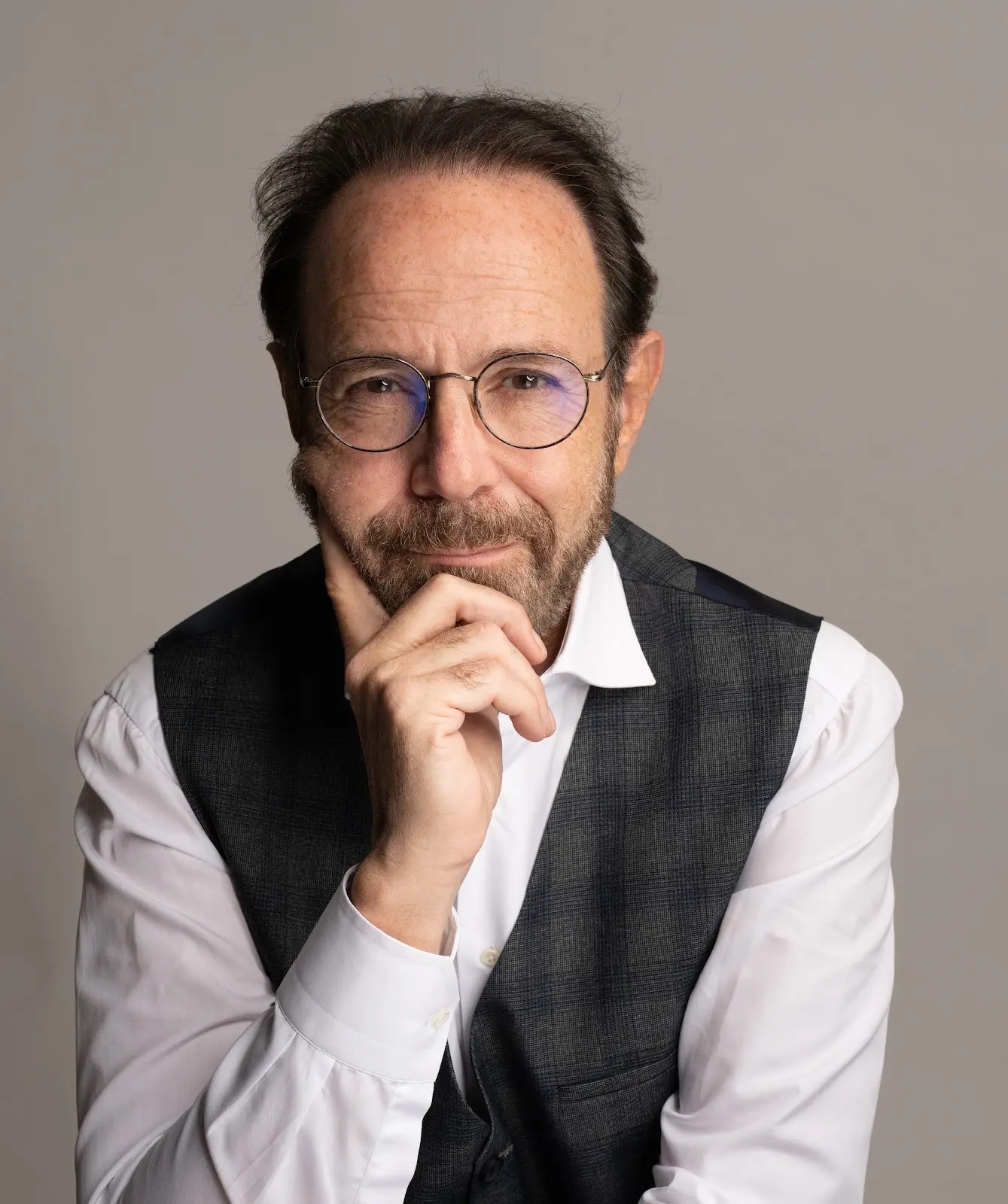
Marc Levy
The Courage to Stand Up
Bestselling French novelist Marc Levy discusses censorship, literature’s power, his father’s past in the Resistance, and why ordinary people can become extraordinary when they refuse to look away.
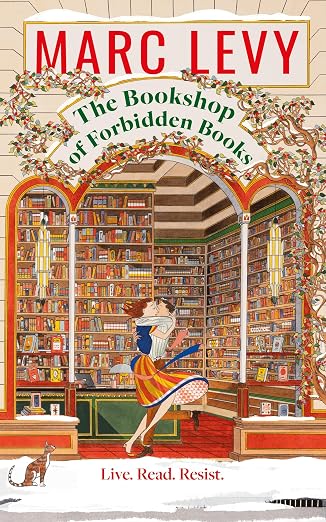
In your new novel, The Bookshop of Forbidden Books, Mitch goes to prison for selling banned books. Of all the ways you could have written about censorship, why choose a bookseller prepared to lose his freedom for it?
Because I think booksellers are cornerstones of democracy. Librarians are already being heavily targeted in the United States. People have threatened them in their own communities, threatened them with lawsuits, and brought them to court. A few have resigned because the pressure was too high, and their crime was simply offering books to readers.
A bookshop is much more than just another shop. It’s a place of culture, where we share our differences and practice understanding and compassion. It’s also an incredibly important social hub, which is why these places are targeted. I’ve recently seen reports in France of far-right people attacking bookstores with Molotov cocktails because they were selling publications they disliked. I wanted to make a bookseller the hero of my book because booksellers are incredibly important to how society functions, yet they get very little attention for their work. Across centuries of literature, there are remarkably few booksellers brought into the light, and there would be no writers without booksellers. I thought it was time to change that.
“The magic of books is that the first book you read makes you understand that you’re not alone.”
Does it worry you that we’re still arguing about which stories people should be allowed to read?
Of course. Am I worried in the long term? No, because I think our societies move in waves. You have a wave of freedom, followed by a pushback from people who hate freedom. We move ahead, then backwards, but the machine keeps moving. When you look at the history of humankind, we are moving forward. Hopefully, not backwards. Knowledge has always been targeted by fundamentalists, conservatives and religious zealots hiding their own crimes behind a pretended morality they apply to others but never themselves. Science books, sources of knowledge, universities and teachers are always targeted by people who hate the freedom of others and want to constrain how they live.
I’m not worried in the long term because these people are eventually defeated. But I am worried in the short term because we’re going through a period of enormous setbacks. I live in the United States, where women’s freedoms have been pushed back decades. If you’d told me four years ago that women would die outside hospitals because surgeons were too frightened of prosecution to provide the intervention necessary to save their lives, I wouldn’t have believed you. But these things are happening. If you’d told me people would brag about putting migrant children in cages, or that prosecutors would find themselves under attack for pursuing the crimes of wealthy people, I would have found that extraordinary.
Even in Britain, I think Brexit was a setback. Everything has become more complicated, and so much of what people were promised was a lie. Yet the people responsible are still appearing on television. Political and social morality is moving backwards right now. But my nature is optimistic. I believe a time will come when the people who caused this pain are sent home, and freedom gets back on track.
Books such as 1984, The Color Purple, The Handmaid’s Tale and Giovanni’s Room appear in Mitch’s world. Isn’t there something almost absurd about trying to make an idea disappear by banning the book containing it?
That’s a very interesting question, because are books mostly about ideas, or about how we feel? I think ideas in books are a way of bringing out our feelings. The magic of books is that the first book you read makes you understand that you’re not alone. There are other people out there who might not look exactly like you, but with whom you share common feelings.
If you read about the life of a mother thousands of miles from your home, with a different colour of skin, a different religion and a completely different life, what will strike you is that she’s a mother just as you are a mother. Or he’s a father just as you’re a father. I think autocrats fear books because they bring to light our resemblance and reassure us of our differences. That sense of nuance, emotion and feeling is the heart and blood of literature. Banning a book won’t erase those feelings. It’s just going to silence them, but the feelings won’t disappear.
This has been happening for as long as books have existed. We know about book burnings, journalists being persecuted, writers being assassinated in Russia and bookshops being attacked. But on the optimistic side, it shows us how powerful books are.
The pen is mightier than the sword, as they say.
It’s funny that in the world of my novel, legislators are banning books but not guns. It’s a very sincere admission of their weakness. They’re more frightened of books than weapons, and that tells you a lot.
I can’t get my head around that contradiction.
When I wrote the book, I was mainly inspired by what started in Florida and then spread to other states. Although I deliberately created a town that could be anywhere, in any country, the story was influenced by what was happening in the United States.
I remember Ron DeSantis talking about protecting young people from books that might supposedly harm or traumatise them, while at the same time supporting the relaxation of gun laws. I found that contradiction extraordinary. Here was a politician presenting books as a danger to children while arguing for greater freedom around firearms. I thought, what a dumb guy! How could he not see the absurdity of those two positions?
But perhaps that’s good news for us. I don’t manufacture weapons. I write books. So if they’re that frightened of books, it shows how powerful we are.
“My father was one of the kids on the bus who stood up.”
Has there ever been a banned or controversial book that had a particular effect on you personally?
Oh yes. The Grapes of Wrath. It’s incredible. My father never forced me to read anything, but he said, “You know what? You should read that book.” I read Steinbeck when I was probably fifteen or sixteen, and it had an immediate effect. I genuinely believe that if I joined the Red Cross at eighteen and worked there for almost seven years, it would never have happened without that book. Those seven years became an absolute pillar of my life. They changed its course.
It’s very cliché to say Steinbeck made me join the Red Cross, but his book completely changed my view of the world. When I read it, I began to understand the world’s vastness, the similarities between human beings, and what makes us human. I was deeply moved by those characters and what they went through. I discovered the rage of injustice in Steinbeck’s literature.
I’d been bullied at school when I was young. I was enraged because I wanted to fight back, but I wasn’t strong enough to fight the bully. Then, through that book, I encountered people suffering a thousand times more than I did, feeling some of the same emotions but finding courage instead of rage. It really changed my world.
Did seeing people at their most vulnerable during your Red Cross years change the person, and eventually the writer, you became?
Certainly, I think one of the temptations when you’re a writer is to write about yourself. I never did that because the lives of the hundreds, if not thousands, of people I met during those seven years showed me that I was far more interested in other people’s lives than my own. I already knew my own life because I’d lived it!
I don’t want to sound naive. When you work for the Red Cross, you inevitably meet some very shitty people. You meet people who’ve caused terrible things to happen, like a drunk driver who’s just killed somebody. But mostly you see incredible people, and their courage. Sometimes, because of prejudice, they’re people you might never have spoken to because you didn’t think you had anything in common. Then you meet them in extraordinary circumstances, and their humanity surpasses everything else. You’re amazed by them. You want to talk about these people. You want to bring them into the light.
There’s an expression in French, fil rouge, a red thread running through something. The common thread in all my books is ordinary people, like me, confronted by extraordinary events in their own lives. Not the end of the world, necessarily, but something extraordinary for them. And how those events make them behave in extraordinary ways. The Red Cross probably gave me all the seeds of those stories.
“I discovered the rage of injustice in Steinbeck’s literature.”
Your father was in the French Resistance. When you write about freedom and standing against authority, how much of him is somewhere in those pages?
A lot, but not necessarily the father I knew growing up. When he joined the Resistance, he was eighteen. It was 1943, when Nazi Germany occupied much of Europe and Britain had endured the Blitz. Many people believed everything was lost. They thought there was nothing left to do but accept their fate. That has resonated throughout my life, including when I was eighteen and working with the Red Cross.
The lie of authoritarianism is that we have to accept our fate. That the forces against us are so overwhelming there’s nothing we can do. I strongly believe that resistance with a capital R is a combination of many small, individual acts of resistance.
Not long ago, I was talking to somebody in France who was leaning towards the far right. He was making arguments about security and violence, saying that every day you read about somebody being attacked on the Metro. I said, let me ask you a question. Imagine one or two people attack somebody on a bus or train, but there are twenty other passengers. You know that if one passenger stands up, another ten probably will too, and the attackers will be overwhelmed. So my question is: if you’re on that bus, will you stand up, or will you read about the attack in tomorrow’s newspaper?
It sounds simple, but it matters to anyone willing to trade freedom for security. The Nazis and those who collaborated with the Vichy regime also claimed to be bringing security, which was absurd given their violence. My father was one of the kids on the bus who stood up. And I think that if you stand up throughout your life, you might not necessarily be rich at the end of it, but you’ll have lived a rich life.
That’s what I’m trying to explore in my books. Standing up can be a very humble act. You don’t have to be a hero. In France, one of the lines associated with the book was that not all heroes wear capes. And it’s true. Heroes don’t necessarily feel like heroes. Whenever I asked my father why he never talked about the Resistance, he would smile and say, “What do you want me to say?” I’d tell him he was a hero, and he’d reply, “I was no hero. I did what I had to do, what everyone should have done.”
You could argue they were simply ordinary people doing what ordinary people should do.
That’s what he was always saying.
Whereas too many people just follow the line. History might have been very different if more people had behaved like that.
Yes, and books spread that sense of normality. Books give you courage. Stories about ordinary people behaving as human beings should encourage you to behave the same way, because you don’t feel isolated. You feel you belong. One of the reasons people don’t stand up on that bus is that everybody thinks they’re alone.
When the first person stands up, others often follow because they suddenly don’t feel alone anymore. That’s exactly what authoritarian and violent people want you to believe: that you’re alone.
It’s like what you said earlier about some people finding books more dangerous than weapons. I’m ex-military, so my instinct would be to stand up. But people are understandably frightened of being attacked or stabbed. Perhaps they don’t realise others might stand with them once somebody makes that first move. Hopefully, that tide changes.
I hope so too.
“The lie of authoritarianism is that we have to accept our fate.”
You didn’t publish your first novel until you were 37. Before that, did you secretly think of yourself as a writer, or would that have sounded ridiculous?
No, I never thought about it. I think we’re defined by what we do, but I never look at myself in the mirror because the guy looking back is much older than I feel!
I see myself as the father of my children, the husband of my wife, the friend of my friends, and a guy who writes books. I don’t need titles. I think the biggest challenge in our personal lives is the quest for our own identity. At 65, I haven’t understood much about it, but I have understood one thing: identity is a moving process. Putting a label on yourself means that label can stick to you and restrict you.
You mentioned a moment ago that you were in the military, and now you’re doing interviews about books. It would be stupid to ask whether you’re military or whether you’re into books. You’re the sum of everything you’ve done, everything you are and everything you will become. And that sum keeps growing.
Some people define themselves by their jobs all their lives. If you’re a doctor in a small community, you’ll always be the doctor. But that’s almost like wearing a raincoat with the word doctor written on it. You’re not just a doctor. You’re a human being with a whole life, problems, experiences, and everything else.
I love exploring that in my writing. All my books are about the quest for identity. As I said earlier, I write about ordinary people confronted by extraordinary situations. Those situations change them because they open a window onto parts of their identities they never knew existed. In The Bookshop of Forbidden Books, Mitch begins to understand who he is while he’s in prison. One of the strongest moments comes when a guard starts secretly passing him books. There’s this complicity, this shared secret, between the imprisoned bookseller and somebody who once bought books from a shop.
I hope readers believe I’m a writer when they read my books, but I don’t need to define myself that way. Before my first novel, I never imagined I’d write books. It happened entirely by accident.
“You are the sum of all you have done, and you are, and you will be.”
You’ve sold more than 50 million books, so whatever you call yourself, it’s clearly worked! One final question, although I could happily talk to you all day. Is there a story you’ve carried around for years that, for whatever reason, you’re still not ready to write?
That’s happened several times. I’ve written 28 novels, and some took a very long time between knowing I wanted to write them and feeling ready. There are three reasons. The easiest to understand is that some books require years of research and documentation. Others take time because you’re not emotionally ready to write them. And the third is that you’re not technically ready.
We have this romantic image of the lonely writer sitting by candlelight with a pen, but writing is a process. Like being a musician, actor, painter or sculptor, you learn by doing the work. Of course, there are those geniuses who make the rest of us look terrible. Forget Mozart! But 99 per cent of people working in creative fields learn their craft as they go. Some stories require techniques you haven’t developed yet.
There are one or two books I’d really love to write, and for one of them I still haven’t found the technical way to tell the story. It’s so interlaced and complicated that I’m still trying to find, as mountaineers would say, the route up the mountain.
Hopefully you’ll find it, and we can talk about it next time. I’ve got plenty more I’d love to ask you.
Whenever you want, we can do this again anytime.
The Bookshop of Forbidden Books by Marc Levy, translated by Tina Kover, is out now.
Interview by Carl Marsh


LATEST INTERVIEWS
David Morrissey
Alicia Coppola
Sorabh Pant
Simon Reeve
James Norton
Heida Reed
INTERVIEW DIRECTORY