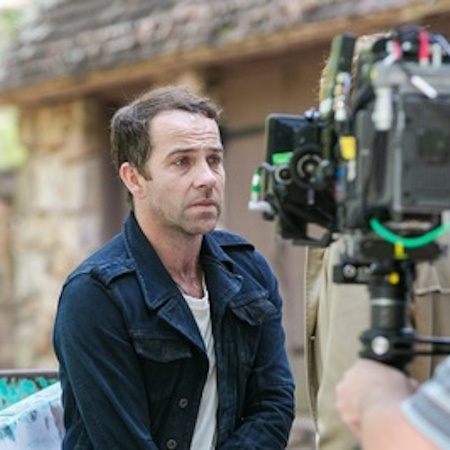

Steven Cree
The Roles, the Rejections and the Stories Between
From Outlander and the West End to working with Emma Thompson and Scott Adkins, Steven Cree reflects on ambition, rejection, old friendships and hilariously awkward encounters.
It’s been a few years since we last spoke properly, Steven. What’s been happening in your world, and how has life been treating you?
God, I mean, work-wise, it’s been pretty busy. I can’t remember what I was doing when we last spoke. Was it A Discovery of Witches? The Twin? God, yeah, that was a while ago. I did The Diplomat with Sophie Rundle in Barcelona, which was great fun, but it got cancelled after one season, as some of these things do. It’s been quite a varied bunch of genres over the last few years, and because I’ve been dotting in and out, doing a bit on this and a bit on that, I’ve probably been on more different projects. Down Cemetery Road, I Swear, which ended up being massive. I have to say, when I was doing it, you never know when something’s going to grab, but I had no idea it was going to explode to that degree. I’ve had quite a few things come out recently, and friends or people on Instagram have been messaging me saying, “Do you ever stop? You’re in everything right now!” But the reality is that people never see the gaps. I remember a friend saying that to me years ago. People only see when you’re back in something, so they don’t see the gaps. Unless you’re in a soap, or maybe you’re in the 0.0001% of actors who genuinely get to pick what they’re doing, there’s always time in between. I had a period where All of You came out on Apple TV with Brett Goldstein and Imogen Poots, which was brilliant. I loved it. Down Cemetery Road came out, I Swear came out, and all three were really big hits at the same time. I don’t think I’d ever had a period like that before, where I’d been in several things that came out together and really landed. Most people don’t see most of the stuff you’re in, I have found anyway. Outlander has its fan base, but it’s not often you’re in something where it feels like everyone’s seen it. I Swear and Down Cemetery Road were very much like that.
But there’s this idea that you’re working nonstop. I’ve had a huge gap this year. Most of the things you audition for don’t go your way, and that’s just the way it is. When I’m at Outlander conventions speaking to fans, there’s sometimes this assumption that at this level or stage you have a choice about everything you do. It’s like, “Why did you do that job?” Well, I auditioned for it, they offered it to me, and I was getting paid money to do it! I’m a single parent who has to pay bills. Obviously, there are projects where you read the script and think, “I’d absolutely love to do this,” but by and large, there have been periods this year when I’ve been slightly tearing my hair out wondering when the next income is coming. Then suddenly Vigil was out, Queen at Sea came out, which I filmed three years ago with Juliette Binoche and Tom Courtenay. I’ve only got a small part, but the film’s incredible. One Last Shot came out with Dolph Lundgren, and there’s been a trailer for Ghost Soldier, which I did last year. I also made a film earlier this year called Bare with Isla Fisher and Colin Firth, written and directed by Lorna Tucker, which I think is going to be incredible. And now I’m doing this ITV show, Code Zero. So I understand why, from the outside, it looks as though you’re nonstop, but there are always gaps.
“I think now success would be like just being content, being content and being peaceful.”
With One Last Shot, I’m a massive fan of the almost continuous takes. I know there’s clever editing involved, but watching it, I kept thinking how daunting it must be for an actor. You’ve got the dialogue, the camera moving around you, and if somebody gets something wrong, you’ve potentially got to do the whole fucking thing again.
Yeah, yeah, absolutely. James Nunn, the director, has clever cuts in there to make it seem like one long continuous take, but we’re still doing twelve- or thirteen-minute takes. From the acting side, I’ll be honest, when I auditioned for that job, I wasn’t entirely sure about it. I grew up on action movies in the eighties. Dolph Lundgren, Jean-Claude Van Damme, Schwarzenegger, Bruce Lee movies, even the old-school action movies like No Retreat, No Surrender. I absolutely loved that genre. But now it’s become, very unfairly as well, a bit of a specialist genre. Some of Scott Adkins’ films are regarded as straight-to-DVD or straight-to-streaming, although they’ve got a very strong fan base. I didn’t really know what the One Shot movies were about, and at first I wondered whether the continuous-take thing was a bit gimmicky. I thought, is this going to be a B-movie or something? Then I spoke to James, and he explained how they were doing it. There’s a scene where I’m fighting Scott on a speedboat. Bearing in mind, I don’t do martial arts. The speedboat’s moving, I get blown off it into the water, and then I swim to shore. I said, “How do we do that?” He said, “You do it.” I said, “What? No stunt double?” He said, “We can’t. The camera is one take. You have to do everything.” And I thought, right, okay, I definitely want a piece of this!
It was one of the most exhilarating, if not the most exhilarating, filmmaking experiences I’ve ever had. Aside from doing twelve-minute takes with ten pages of dialogue, which is daunting enough, it’s low-budget, so you don’t have much time to rehearse. You really have to hit the ground running, and you’re on all the time, all day. Sets can sometimes be boring when you’re waiting for setups or lighting, and it’s very stop-start. Filming this way was much more like theatre because you really get into it. Everyone, from makeup to the grips, runners, director, actors and costume, was working together. It was like a family, and everybody wanted to make the absolute best film they could. Trying to do long takes with action sequences is fucking hard. Scott Adkins himself is at the top of the tree for what he does. Watching him and Kane Kosugi, who’s a big martial arts star as well, was incredible. I actually asked to come in on days when I wasn’t working because I loved the atmosphere so much. Watching Scott and Kane fight was like watching two world-class ballet dancers doing their thing. These guys have been doing it since childhood. Anyone can say lines, really. Clearly, some people are better at it than others, but you’re watching people who’ve developed this extraordinary skill set, and I just absolutely loved it. I came off that job genuinely thinking, and I mean this in a kind way, I didn’t care what people thought of the film because the experience had been so incredible. You obviously want people to enjoy it, but you’ve got no control over that. It had an almost arthouse feel to it, a real creative feel. From the outside, people might just see an action movie, but I think you’d have to experience something like that to appreciate what goes into it. My appreciation for action stars is even greater now.
“There should be no snobbery about any of it at all.”
It must have been a childhood dream, then, to play a villain in an action film alongside somebody like Dolph Lundgren.
Totally. There was a moment after it came in where I was thinking, do I want to do this? I said this to my agent. I was maybe being a little bit snobby because I’d just done this film with Juliette Binoche, and I wondered whether this was what I wanted. Then I thought, hold on a minute! That’s the incredible thing about acting. There really should be no snobbery about any of it at all, whether it’s Shakespeare, pantomime, soaps, movies or whatever. The great thing is the variety. Queen at Sea is one of the most incredible and beautiful scripts I’ve ever read in my life, and that film’s so special. But then getting to do something like One Last Shot is amazing as well. They’re so different. If you’d said to me as a six- or seven-year-old kid, after watching Rocky IV with Ivan Drago, that I was going to make a movie when I was older where I was the bad guy and Dolph Lundgren was in it as well, I’d have thought, well, I’ve made it, surely! I think there’s something special about paying tribute to that little kid in you. Particularly in this business, where you get to go to work and pretend. You’re trying to tell the truth as much as you can, but you get to go to work and pretend. I’m an American Marine who’s turned against his country, concocted a terrorist plot, and I’m having fights on speedboats. It’s amazing!
I didn’t actually get to work with Dolph. We’re in one scene together, but I’m dead! Even meeting him was incredible. He’s an icon. Dolph Lundgren, like Schwarzenegger, has transcended acting, and they’ve become something else entirely. You see when you meet him why he became who he became. He’s got an incredible presence. He’s a real specimen, and he looks incredible. He’s made of granite. He’s had so many injuries over the years, but he still looks amazing. We were actually talking at work about Swedish people and how incredible everybody looks in Stockholm. They’re all really well dressed, with incredible bone structure. We were comparing it with Wales and Scotland, and I don’t think people visit our countries and necessarily come away with quite the same perception!
“I still love getting a call and saying you’ve got the job.”
Looking at your credits, you’ve got Outlander, A Discovery of Witches, Vigil, The Diplomat, horror films and action films. Have you actively chased that variety, or is it simply a case of what gets offered to you?
I think, to be honest, it’s luck. I’ve always loved the idea of luck. Paul Newman is my favourite movie star from that classic era. Not necessarily my favourite actor ever, but I just loved him so much and loved his films. He spoke a lot about luck being prevalent throughout his life. He said he was lucky to be born with those blue eyes and a face people loved, because it took him a long time to act. He looked back at his early films and thought he was terrible for the first ten, fifteen, twenty years of his career. But he was born with that face and those eyes at a time when that was what people wanted, and he had no control over it. I really subscribe to that theory. I remember speaking to Tom Wilkinson about ten years ago when we were doing a film together, and we were talking about luck. Tom said, “I don’t believe in luck.” I said, “But there has to be an element of luck.” I mentioned The Full Monty. Tom was already a brilliant, highly esteemed actor, but nobody thought that film was going to become what it became. I know Robert Carlyle as well, and nobody thought it was going to explode like that. It changed careers. There’s an element of luck around that which you just can’t control.
Scott Adkins and I were talking about this. Scott was a huge Bruce Lee and Jean-Claude Van Damme fan, and he wanted to become the next Van Damme. He went into karate and kickboxing, and that’s what he set his stall out to do. I loved Van Damme and Bruce Lee films too, but I also loved musicals. So I set my stall out to do musicals, and when I was 27, I got to play Cliff Bradshaw in Cabaret in the West End. That was the absolute dream. Interestingly, I met up with a guy called Steve Balsamo recently. Steve played Jesus in Jesus Christ Superstar in 1996, and when I was sixteen, I made a pilgrimage to London to see him in the show. I got my photograph taken with him at the stage door afterwards. Ten years later, when I was doing Cabaret, I looked him up on Facebook and told him the story. I said, “I’m now doing a show in the West End, and you were such a huge inspiration to me.” He got back to me, and we became friends. We’ve kept in touch over the years, and we were sitting together recently talking about how that was thirty years ago. It’s gone so quickly. But looking back over those thirty years, it’s easy to lose sight of how far you’ve come. Somebody asked me recently whether I still love acting or whether it’s become just a job. Sometimes you go into work, and it is a job. I love it, but it’s not always easy, and sometimes you’re doing something really hard. Each job is different. It’s easy to forget how lucky I am that I’m one of those people who, as a kid, said, “This is what I want to do when I grow up,” and I’ve got to do it.
After Cabaret, I really wanted to do movies. I partly believe in the power of manifesting and putting things out there, but I also used to like believing that everything happens for a reason. As I’ve got older, I’ve realised I only really believed that when things were going the way I wanted them to. There are so many terrible things happening around the world that I don’t believe everything happens for a reason. I believe things happen. Life gives you lemons and you make lemonade. In hindsight, you can find lessons in what’s happened and how circumstances have shaped things, but whether something was meant to happen, I don’t know. Before I got Cabaret, I’d been out of drama school for six years and barely worked at all. I had a terrible time. Then, when I was 26, I got my shit together, got sober and sorted my life out. I spent about eighteen months trying to get a really good agent, and Ken McReddie took a chance on me. He was like a grandfather to me, and I don’t know whether I’d have had a career without him. Two weeks later, I got an audition for Cabaret, and I got it. It changed things massively. But there was such a sequence of lucky events that led to it happening. Was it destiny, or was it opportunity meeting timing and hard work?
I’m trying to make a film right now that I’ve written called Ben & Lucy. There’s been a bit about it online, and we’re in the process of getting it made. Hopefully, the idea is to make it in the second half of next year. It’s moving along, and it’s exciting. When you create something yourself, there’s a different element to it because it doesn’t happen without you. One of my good friends is Brett Goldstein, and I’ve always watched him from the sidelines with such admiration. He’s the hardest-working person I know. When somebody writes and creates something, that thing doesn’t exist without them. You still need luck, you still need a break, and you hope producers, directors and cast are going to like what you’ve done. But it’s slightly different from auditioning for a job and either getting it or not getting it. I think I’ve probably answered about fifteen questions there!
“My Scottish accent is fucking terrible.”
I knew what you were like, so I’ve got a few questions here you’ve already answered before I’ve even asked them! But you’ve played some memorable characters. Which one have you enjoyed playing the most, regardless of how successful the production became? And which character would you happily spend another six months playing?
Cliff Bradshaw in Cabaret will always be one of the most incredible experiences I’ve ever had. In a way, nothing will ever equal it because of where I was at that point. I was 27 and a half, working in restaurants, bars and offices. I’d been out of drama school for six and a half years, and I genuinely thought, “God, am I deluded? Maybe I can’t do this after all.” I thought it was going to be easy. I’d done very well in my final year of drama school. I was let out twice to do two professional jobs, and I genuinely thought I’d leave drama school and become a movie star. I thought that was what happened! This was 2001. The internet was in its infancy, social media didn’t exist, and I didn’t have any idea how the entertainment industry worked. I grew up on a council estate. I didn’t know anybody in the business, and I didn’t really know what actors did. I didn’t know there was an in-between. I didn’t know you did an episode of Doctors, The Bill or Holby City. I thought, well, I was the lead in my school shows, I did well at drama school, so I guess the next thing is becoming a movie star. It was part delusion, part belief, but I also just didn’t have a fucking Scooby!
For six and a half years, there was almost total unemployment from acting. I thought, “Fuck, this isn’t going to happen.” I was working in a restaurant, and I could either go into work on the Monday to continue being a waiter or go in for my first day of rehearsals for Cabaret. When I got the phone call, getting to phone my mum with good news for a change was unbelievable. That’s the stuff of dreams. It was made all the sweeter because I’d had virtually no success before that. I thought I’d fucked it. I’d missed the boat. I was always so hard on myself. “You’ve missed the boat. You’ve missed the boat.” I was 27 years old, and I didn’t even know what boat I was supposed to be getting on! But in my head, I’d missed it. I loved going into the West End six nights a week. Cliff is such a fantastic, multilayered part, and Cabaret is a phenomenal show. More than anything, it gave me belief in myself. It made me think, “Oh, I can do this.”
Outlander will always be super close to my heart too. For me, jobs are really about the people. That’s why I loved One Last Shot so much. You can have a phenomenal script and phenomenal actors, but the lasting experience is about the friends you make and the people you meet. I love connection. I love meeting new people. Gallowglass in A Discovery of Witches was a great character. Getting to play a rock-and-roll, 700-year-old vampire, even on paper, sounded like great fun. I’d also love to explore my character in Down Cemetery Road more, mainly because I got to work with Emma Thompson. Any good things you’ve ever heard about Emma, multiply them by a million. She’s an absolutely incredible human being. She’s just fantastic. The part I’m playing right now in Code Zero is another one I’m really loving. He’s a great character, and we’ll see how it turns out. He’s the bad guy, to put it simply. People always ask whether it’s more fun playing the nice guy or the bad guy, but it doesn’t really matter. There can actually be a cost to playing somebody who’s not nice all the time. It’s emotionally taxing and takes a lot of energy, but it can be fun.
“People never see the gaps.”
Are you finding yourself more comfortable playing those darker characters now?
It’s funny how it goes in waves. For two or three years, I was playing really nice guys. In All of You, I play such a nice guy. Some of the reviews were almost saying he’s so nice that he’s boring. He’s a good friend, a good parent, a good husband. But I loved it. I thought the script was brilliant, and I loved that film so much. Ian Murray in Outlander is probably the nicest guy in that show. He’s the real moral heartbeat of it. Gallowglass was edgy, but he was still a good guy. Then suddenly Down Cemetery Road comes along, and he’s a bit dodgy. He’s not necessarily bad, but he’s a bit dodgy. In I Swear, my character isn’t a particularly nice father. He tries to be, but he can’t handle what’s going on with his son and walks out on the household. In One Last Shot, I’m the bad guy. In Vigil, I played a politician who thought he was doing the best for the country. That’s what’s interesting about those characters. They’re the bad guys in the story, but in their own heads, they don’t think they’re doing anything wrong. The soldier in One Last Shot believes he’s been shafted by his country, so he thinks what he’s doing is justified.
In Ghost Soldier, I play quite a dodgy lawyer, and now in Code Zero, I’m playing another character who’s not particularly nice. There’s definitely been a theme going on! I think you’re probably reinventing your career all the time without even realising it. Producers and casting directors see you doing something, and perhaps if you’ve played a bad guy in something prominent, for a little while you’re in people’s heads as somebody who plays a nasty character, or somebody who’s angry. Being Scottish as well, you can sometimes find yourself in the category of angry alcoholics or something like that! But it just goes in waves, and I’ve been lucky enough to have the variety.
“It was one of the most exhilarating, if not the most, filmmaking experiences I’ve ever had.”
Do you ever watch yourself back and think, “Bloody hell, that was good,” or are you your own worst critic?
I can tell you that I watch stuff back sometimes and think, “Holy fuck, I’m horrific! How do I get any work?” Ron Moore, who was the showrunner on Outlander, posted a deleted scene involving my character on Instagram the other day. I watched it and thought, oh my God, not only is my acting horrendous and unbelievable, but my Scottish accent is fucking terrible! I sound like I’m putting on a Scottish accent. I was cringing with embarrassment. I still posted it anyway because I thought it was funny, and I can accept that. I can definitely watch something and think I’ve serviced the story the way I wanted to, or conveyed what I wanted to with the character. But I can’t imagine sitting there thinking, “Fucking hell, man, I was brilliant!” I’m sure some actors do. I’ve worked with a couple! But I don’t know many who watch themselves and think they’re amazing. I might watch something and think my hair looks great, though. I’m quite obsessed with my hair. Anyone who knows me knows that. Most actors I know go into ADR, the additional dialogue recording, and come out devastated because they’ve had to watch themselves and thought they were shit. It’s such a weird thing because you don’t necessarily know how you come across to other people. When I’m watching myself, I’m seeing something very different from what you’re seeing.
I remember doing The Twin, and I thought I’d done a pretty good job. I was happy with what I’d done, and I thought it was a good movie. The reviews were mixed, ranging from pretty good to glowing, but there was one review that still makes me laugh to this day. You probably shouldn’t read reviews, but I was interested. One of them said that Steven Cree exists in this movie only to make you think how much better someone else might have been. I laughed when I read it, but I thought, my God, that’s so brutal! Somebody’s watched that and thought I’m so shit that all I do is make them wish somebody else had been in it. But I also thought it was quite a funny way of phrasing it. It’s savage, but it makes me laugh.
If you could go back to the years before you got Cabaret, what would you tell that younger Steven to stop worrying about?
Oh my God! Money, for a start, simply because I still worry about it. Why are we who we are? Part genetics, part conditioning, nature and nurture. I grew up with very little money. My mum and dad divorced when I was seven, and we moved onto a council estate. My mum was incredibly aspirational. She went back to college and retrained as a chiropodist because she wanted to make the best of her life and mine and my brother’s lives, but money was always an issue. I remember her constantly robbing Peter to pay Paul. Her Burton’s card was maxed out, another card was maxed out, and paying the bills each month was a struggle. But we still had a nice enough life within that. Then I became an actor and spent years working in bars and restaurants in London, and I was so skint all the time. I think my overdraft was minus £2,000, and if I had minus £1,990 in my account, I felt rich because I had a tenner left! That’s not even an exaggeration. I’d buy my travelcard, have a budget for food and a budget for everything else, and I couldn’t deviate from it. When I was still drinking and being quite wild, I wasn’t particularly responsible, but after I stopped drinking, I had to be careful. I look back on those years with such fondness now. At the time, they were a real struggle, but they were also amazing days. There’s something about having fewer choices. Over the twenty years since, I’ve discovered that I’ve always ended up being okay. Compared with where I came from, I’ve been incredibly lucky.
I’d also tell myself to stop worrying about what people think of me. I definitely cared about that far too much as a young guy, and that was before social media was around. I compared myself to other people terribly. It’s an industry where you can be doing well, whatever that means, but somebody else is doing something bigger and you start thinking, “Well, I’m not doing that.” You say you don’t care what people think, but then you go a year without work and think, “Oh shit, does everybody think I’m shit?” And then you read a review saying you’re only in a film to make people think how much better somebody else might have been! You don’t want to care, but if everyone thinks you’re shit, you’re not going to get a job. You have to care a little bit, I suppose. My perception of success has changed massively. Back then, success was being on the cover of GQ, being the lead in a movie or television show, making a certain amount of money, or having a particular status in the industry. All those capitalist ideas of what success looks like. And it tortured me because I could be doing A Discovery of Witches or The Twin, things I could only have dreamt of during those six or seven years when I couldn’t get a job, and still think, “Yeah, but I want to get to that next level.” The problem is that there’s no final level. You reach one peak and immediately want the next one. If you’re constantly focused on the destination, fuck me gently, you miss so much of the journey. I look back at those days working in restaurants and pubs in London with such fondness now, but at the time, I was wishing them away. I was wishing my life away.
I’m 46 now, and I’ve got an eight-year-old daughter. I sometimes see that little critical voice appearing in her already, and I think, “Oh my God, it starts so young.” She criticises herself, and I just want to tell her to love herself. People sometimes say somebody “loves themselves” as though it’s an insult, but what a wonderful gift that would be, to genuinely love yourself. There’s so much to worry about in the world right now. AI is developing at an extraordinary pace, global warming, Yemen, Sudan, so many situations where things feel overwhelming. I look at my daughter and think, what’s actually going to happen? But if you spend your life worrying about everything you can’t control, you’ll never find peace. That’s not to say you should sit back and do nothing. You have to think about what action you can take, but also recognise the things that aren’t in your control. I’ve had some quite profound lessons in the last few years. I love acting, and I’m very lucky and grateful for where I’m at, but I’ve realised that all the shiny stuff doesn’t necessarily deliver what you think it will. It’s those moments sitting with Steve Balsamo, talking about meeting him thirty years ago, or moments with my daughter when she’s taking joy in something completely innocent. Those are the things that make me feel genuinely happy. Going to award ceremonies and all that stuff isn’t quite what I thought it would be when I was younger. Now I think success might simply be being content and peaceful. I’m not quite there yet, but that’s what I’m aiming for.
“I love connection. I love meeting new people.”
What’s the one part of the acting business you still absolutely love, and the one thing you’d happily never have to deal with again?
I still love getting a call saying you’ve got the job. It’s like a drug. It’s the dopamine hit, the rush. Somebody likes me! I’ve been validated by seven or eight or nine or ten people I’ve never met before who’ve watched my audition tape and decided I’m the one. That always still hits, especially if it’s a job you really want. I think David Tennant once said something like that’s the best part, and then afterwards you have to go and do the job! The reality sets in. But I love doing the job as well, and I still love auditioning. On the very rare occasion I’m just offered a part, which doesn’t happen much, it’s different because you feel like you haven’t earned it. That said, if somebody phoned and said Spielberg had seen something I’d done and wanted me in his next movie, I’d probably be pretty excited!
The thing I could happily do without is self-taping. I understand why it’s become the norm, and there are advantages. Wherever you are, you can fire off a self-tape and give yourself an opportunity. Actors who can’t afford to live in London can audition from all over the place. I’m sure there are advantages for casting directors and producers as well. But I really miss going into the room. I’m a people person, and clearly I’m a talker and a communicator. I’m a verbal communicator, as my therapist says! Art is about many things, but it’s also an exchange of ideas. I miss going into a room and saying, “Hey, how are you all? Love the script. I’ve got this idea. What do you think?” It still exists, but it’s not as commonplace now. With self-taping, you’re responsible for the camera, lighting, sound, finding somebody to read opposite you. Sometimes you can’t get anyone, so you’re reading with somebody over FaceTime, and the connection breaks down. I miss going into Soho at eleven in the morning on a Tuesday for an audition. Even though it was unpaid, it felt like going to work. You were getting up, getting your head in the game, and for fifteen or twenty minutes, you were going into a room to connect with other people.
There’s something that worries me about the future with AI and technology. I don’t want to lose human connection. It’s strange because technology is supposed to make it easier for us to connect, but sometimes it seems to make genuine connection harder. As an actor, when you’re not working, you could theoretically spend days alone doing self-tapes in your room, without actually seeing or speaking to anybody in person. And for me, that’s not acting. I want to look at somebody. I want to react to them and have that exchange. You have to move with the times, of course. If I refused to do another self-tape, I probably wouldn’t get any work. So I have to do it. But I miss being in the room. I like people.
“I don’t believe that everything happens for a reason.”
One last question, and let’s finish on something funny. Who’s the funniest person you’ve ever worked with? And don’t give me the diplomatic answer, please!
Oh my God! Actually, without a doubt, Gavin Mitchell. Gavin plays Boabby, the bartender in Still Game. He’s utterly hilarious. He’s just got funny bones. We did Outlaw King together in 2017, and we had two or three nights where we were doing night shoots. You might start at five or six in the evening and finish at six the following morning. The first night’s always funny because everybody’s a bit delirious. It’s almost like a sleepover, except you’re at work and you’re dressed in wigs and costumes. We were all sitting in a tent playing charades one night. Gavin was there, Aaron Taylor-Johnson, Billy Howle, Lorne MacFadyen and some of the other cast. I can’t remember whether Chris Pine joined in. It was one of the funniest times I’ve ever had on a set. Gavin is just one of those people who’s naturally funny. He’s such a great guy, and I love working with people like that. I take the work very seriously, and I’m ultra-professional when I’m working, but I also like having a laugh. For me, that’s one of the bonuses of acting. Getting to have fun, meeting people, spending time together and enjoying yourself while you’re making something. When somebody like Gavin is around, I really riff off that.
Matthew Goode’s very funny as well. We had such a good laugh on A Discovery of Witches. We actually lived together during COVID. Matthew had this amazing luxury house with a cinema room and a gym, and he invited me to stay rather than being in a hotel. It was one of the best experiences I’ve had living away while working. I didn’t know him before the show, and I remember being a bit nervous because I’d always been such a fan of his work. I thought he was so good. But he was so welcoming and made me feel part of things immediately. We hit it off really quickly, and we had a brilliant time.
Actually, the best story I’ve had in the last couple of years happened on Heads of State. On the very first day, Idris Elba walked in on me while I was taking a shit. That was my icebreaker with Idris! He opened the door, looked me straight in the eyes while I was sitting on the toilet, and I just went, “All right, mate.” He ran straight back out, and I shouted after him, “It’s all right. It doesn’t smell!” When I got back onto the set, I wanted to acknowledge what had happened, but Idris wouldn’t make eye contact with me. He was pretending it hadn’t happened. The next day, I went over and said, “Listen, can we just acknowledge that happened? We made eye contact while I was on the toilet.” He said he hadn’t wanted to make a big deal of it, and I told him I thought it was more embarrassing if we didn’t at least admit it had happened!
Steven Cree continues to work across film and television while developing his own feature, Ben & Lucy. His latest film, Ghost Soldier, is now showing in US cinemas and arrives in UK cinemas on 27 November.
Interview by Carl Marsh
Ad · Further viewing
Outlander
See Steven Cree as Ian Murray on MGM+ in the UK.
View the MGM+ offerMGM+ is a paid add-on channel on Prime Video. See Amazon for the current offer and terms.
As an Amazon Associate I earn from qualifying purchases. I may earn commission on eligible MGM+ sign-ups.
More Interviews

Whoopi Goldberg


LATEST INTERVIEWS

David Morrissey
Alicia Coppola

Sorabh Pant

Simon Reeve

James Norton

Heida Reed
INTERVIEW DIRECTORY